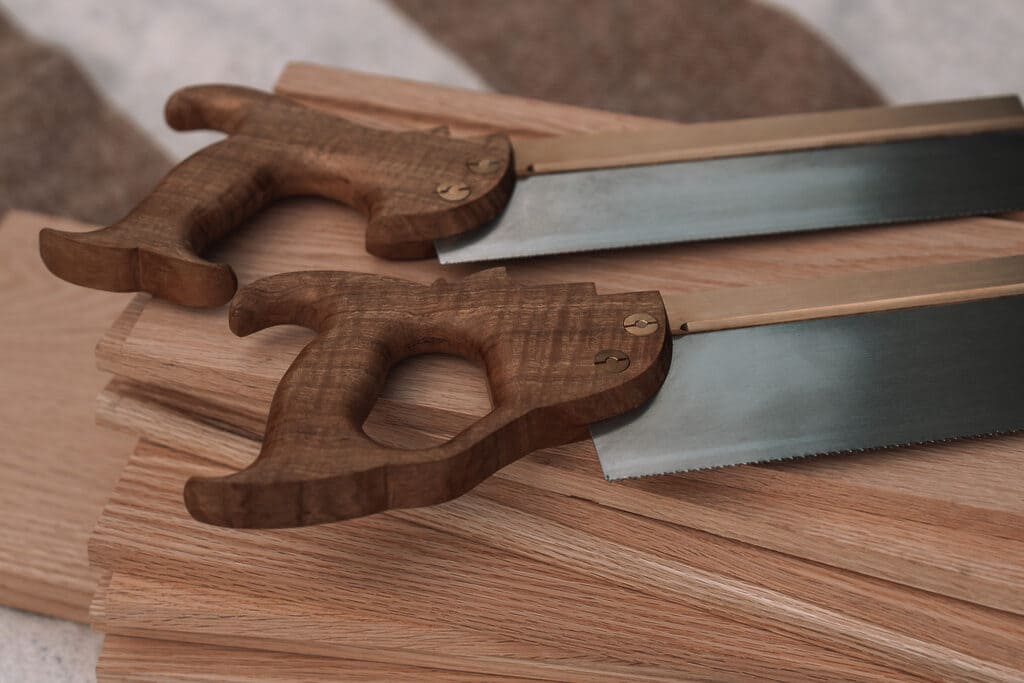
Put one of my dovetail saws next to one of my carcass saws and the handles don’t sit at the same angle to the teeth. That angle is the hang, and it’s one of the numbers on every saw for sale. I touched on it in the parts of a backsaw, but it deserves a post of its own. It changes how a saw feels in use more than almost anything else.
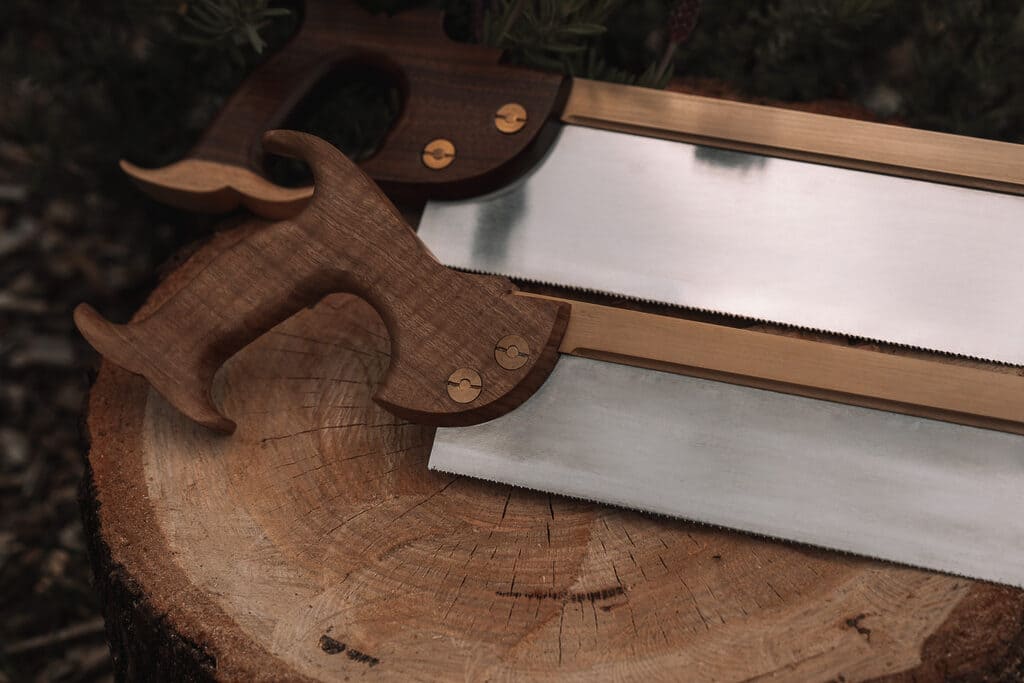
What hang angle is
When you push a saw, the push comes out of the heel of your hand, roughly square to the grip. Hang is the angle between that line of push and the toothline. A high hang points your push down into the teeth. A low hang points it forward, along the length of the plate.
To see it, hold the saw side-on with the teeth level and look at the back of the grip. The further the grip leans forward, towards the toe, the higher the hang.
There’s no single agreed way to measure it. Some makers measure from the back of the grip, some from a line through the middle of it, and a few from the spine instead of the teeth. So a 20 degree saw from one maker and a 20 degree saw from another won’t always feel the same. Mine are all measured the same way, from the toothline, so you can compare my saws with each other.
What it changes
A high hang sends more of your push down into the wood. The teeth bite deeper on each stroke and the saw sinks into the cut without you leaning on it. A low hang sends more of your push forward, so the whole toothline does its share of the work on a long stroke.
When the hang doesn’t suit the saw, you feel it. Too steep for a long plate and the teeth near the handle dig in while the ones at the toe hardly touch the wood. The saw sticks, and you end up easing off partway through every stroke. Too shallow and the saw feels dead. It skates on the surface and you find yourself rocking your wrist forward to make it bite.
My dovetail saws: 41 degrees
A dovetail saw is short, 250mm on mine, with fine rip teeth, and most of its work is cutting down into the end of a board clamped upright in the vice. The strokes are short, and you want the saw to start cleanly on a small corner and go straight down to the line. A high hang helps with that. Your wrist stays straight, your forearm sits behind the saw, and the push goes into the teeth.
A high hang also makes a rip tooth more aggressive, so it pairs well with a little rake to stop it grabbing. That’s one reason my dovetail saws have 8 degrees of rake and not zero. There’s more on rake in the post on the three angles on a saw tooth.
My carcass saws: 23 degrees
A carcass saw is longer, 300mm on mine, filed cross cut, and does a lot of its work across a board held on a bench hook, cutting shoulders and trimming parts to length. The strokes are longer and flatter. A lower hang lines your arm up behind the whole length of the plate, so the teeth at the toe cut as well as the ones near the handle.
Your bench and your body
Hang only works if your arm can line up behind it. Hold the saw with your index finger pointing along the plate and look at your wrist. It should be straight, with your forearm running in line with the push. If you’re bending your wrist up or down to keep the saw level, something’s off.
Often it’s the work height and not the saw. A high-hang saw is comfortable when you’re standing fairly upright over work at normal vice height. Raise the work up, in a Moxon vice or a bench-on-bench, and you end up pushing more level, so a lower hang starts to feel better. Work down low and you’ll be happier with a steeper one. Before you blame a saw, try moving the work up or down a few centimetres.
Hang and hand size
Hang and handle size are separate things. The size of the grip is about your hand, and that’s what I measure your hand for. The hang is about the job the saw does and how you stand to do it. On a commission we can talk about both. If you saw at an unusual height, or you’re tall or short for your bench, tell me and I’ll take it into account.
Checking a saw you already own
You can’t change the hang on a saw you already own without making a new handle, but you can check whether it suits you. Take a few slow strokes in scrap with a relaxed grip. If the saw starts easily, runs to the end of the stroke without sticking, and your wrist doesn’t ache after ten minutes, the hang suits you and the way you work. If not, try changing the work height first. And if you’re still unsure, ask me.